A few years ago, saving money on fast food meant clipping a coupon from the Sunday paper. Today the best prices at most big restaurant chains and supermarkets live inside their apps. The menu board price is what everyone else pays; the app price is for people who downloaded it.
That shift is good news if you eat out or buy groceries regularly, because the discounts are real and often bigger than the old paper coupons. It also means there are a lot of apps, a lot of fine print and a lot of notifications. This guide sorts out what’s worth your time.
Why the deals moved into apps
Chains like apps for two reasons. First, a customer with the app on their phone comes back more often. Second, the app tells the company what you buy, when and where, which helps it decide which deals to send you. The discount is partly a payment for that information.
That trade-off is worth knowing about. It doesn’t mean you shouldn’t use the apps, but it’s reasonable to turn off location tracking when you aren’t ordering, limit notifications to the one or two apps you use most, and read what each app collects in its privacy settings.
Fast-food apps: how the deals work
Nearly every major chain, from burger and chicken places to pizza and coffee, now runs an app with two kinds of savings: rotating deals and a points program.
Rotating app-only deals
These are the offers you see on the app’s deals tab: a free item with a minimum purchase, a set price on a combo, or a percentage off. They change often, sometimes weekly, and many are personalized, so your deals may not match a friend’s.
A few rules apply almost everywhere:
- One deal per order is the norm. If you have two deals you want, it may be cheaper to place two small orders.
- Deals have to be added before you pay. For in-store orders, that usually means scanning your app code at the register or using mobile ordering.
- Deals often exclude delivery. Many app deals apply only to pickup, drive-thru or dine-in.
Points programs
Points programs reward you for spending, and they work alongside the deals. A few things decide whether a program is good for you:
-
How points are earned. Most chains award points per dollar. A few, like Domino’s Rewards, give a flat amount per qualifying order: 10 points for any order of $5 or more. Flat-rate programs favor people who place small orders often; per-dollar programs favor bigger orders.
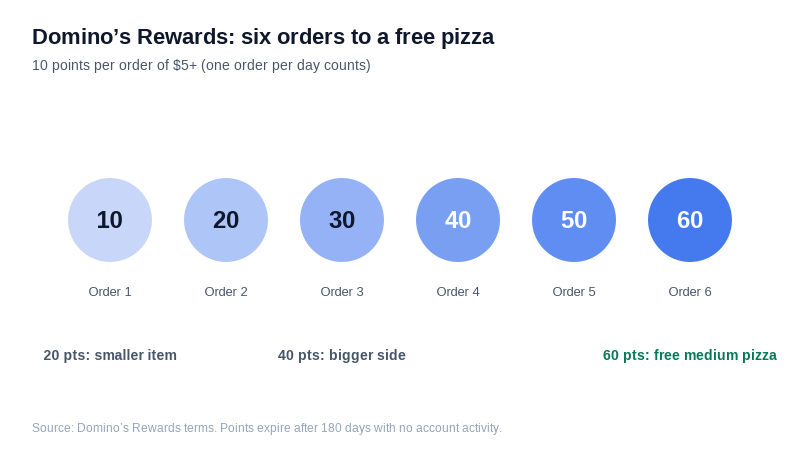
A flat-rate program: every qualifying order earns the same points. -
What points are worth. Look at the reward chart and work out the value of a typical reward. A free drink and a free entree may cost the same number of points but differ a lot in value.
-
When points expire. Many programs expire points after a period of inactivity. Domino’s, for example, clears points after 180 days with no activity on the account.
The delivery-app markup
Ordering the same meal through a third-party delivery app often costs noticeably more than ordering it yourself. Menu prices on delivery platforms are frequently higher than in the restaurant, then you add a delivery fee, a service fee and a tip. Many chains also exclude third-party orders from their points programs.
Watch out: Delivery apps cost more than the menu
Menu prices on third-party delivery apps are often higher than in the restaurant, before fees and tip. Check the restaurant’s own app first.
If you want delivery, check the restaurant’s own app first. If you can pick it up, you skip the fees and often get the better deals too, since many offers are pickup-only.
Grocery store apps and digital coupons
Supermarket apps work differently from restaurant apps. Instead of points per order, most are built around a loyalty account and digital coupons.
Digital coupons
You “clip” a digital coupon in the app, it’s saved to your loyalty account, and it applies automatically when you enter your phone number or scan your card at checkout. Big grocery chains and their sister banners, plus general retailers with grocery aisles, all run some version of this.
What to know:
- Clip before you shop. Coupons usually have to be on your account before you check out. Clipping in the parking lot works fine.
- Watch the limits. Many digital coupons are limited to one use per account, or a single transaction.
- Look for weekly digital deals. Some stores reserve their best prices of the week for app users, so the shelf tag shows the regular price and the app shows the lower one.
Fuel points
Several supermarket chains reward grocery spending with fuel points that discount gas at their own stations or partners. If you have one of those stores nearby and drive regularly, fuel points can be among the most valuable rewards in your wallet. They usually expire after a set period, so plan to use them.
Cash-back receipt apps
A third type of app pays you after you shop. You scan your receipt, or link a store loyalty account, and earn points or cash back that you redeem for gift cards or a transfer.
They come in two broad styles:
- Any-receipt apps give a small reward for scanning almost any receipt, with bonuses for specific brands. The rewards are modest, but it takes a few seconds.
- Offer-based apps require you to choose specific product offers before or after shopping, then match them to your receipt. These pay more per item but take more effort.
Both sit on top of whatever you saved at the store. A box of cereal bought on sale, with a digital coupon, can still earn cash back from a receipt app.
Can you stack grocery coupons with cash-back apps?
Grocery stacking is where apps really pay off, because the layers come from different places and generally don’t conflict:
- The store’s sale price.
- A store coupon, digital or paper.
- A manufacturer coupon. Most stores allow one store coupon and one manufacturer coupon per item, but check your store’s policy.
- A cash-back app offer on the same product, claimed afterward with your receipt.
- Loyalty or fuel points on the total.
Here’s how that could look with round numbers. A $5 jar of coffee is on sale for $4. A $1 digital store coupon brings it to $3, a $0.75 manufacturer coupon to $2.25, and a $0.50 cash-back app offer to $1.75 after you scan the receipt. That’s 65% off, and you still earn points on what you paid. You won’t hit that every time, but even two layers beats paying shelf price.
Quick reference: which app does what
| App type | What it does | Best for | Watch out for |
|---|---|---|---|
| Restaurant app | App-only deals plus points | Places you visit at least twice a month | One deal per order; points expiring |
| Grocery store app | Digital coupons, weekly deals, fuel points | Your main supermarket | Clipping before checkout; per-account limits |
| Cash-back receipt app | Rewards after you shop | Anyone who buys groceries | Small payouts; minimum to cash out |
| Third-party delivery app | Delivery from many restaurants | When you truly can’t pick up | Higher menu prices plus fees |
A 10-minute weekly routine
You don’t need every app. Pick the restaurants you actually visit and your main grocery store, then:
- Before the grocery trip: open your store’s app, browse the weekly deals and clip anything on your list. Two or three minutes.
- Check one cash-back app for offers on what you’re buying.
- Before ordering takeout: open that restaurant’s deals tab first, then decide what to order, not the other way around.
- After shopping: scan your receipt.
- Once a month: check points balances and expiration dates.
Traps to avoid
- Buying things because there’s a deal. A free side with a $15 purchase isn’t a saving if you’d have spent $9.
- Notification overload. Keep notifications on only for the apps you use weekly.
- Forgetting expiration dates. Points and digital coupons both expire, and unused ones are worth nothing.
- Assuming the app price is always lower. Occasionally an in-store combo or a printed coupon beats the app. Compare once in a while.
The bottom line
App deals reward people who are a little organized. Choose a few apps that match where you already eat and shop, add the deals before you buy, and let the points build quietly in the background. That alone puts you ahead of most shoppers paying the menu-board price.
For chain-specific tips, see our Domino’s coupons and Rewards guide and Firehouse Subs Rewards guide, or browse all Fast Food & Dining deals.