Note: This guide is about prices and paying for care. It isn’t medical advice. How often you need an eye exam, and what kind, is a question for a licensed optometrist or ophthalmologist, especially if you have diabetes, high blood pressure, glaucoma in your family or any change in your vision.
If you don’t have vision insurance, the first quote can be a shock. A comprehensive eye exam at many private practices runs about $100 to $200, and a single pair of glasses with common upgrades at a traditional optical shop can cost $200 to $400 or more. Put those together and you’re easily past $300 for one pair.
It doesn’t have to cost that. Separating the exam from the glasses, using bundle deals from chains like America’s Best, paying with pre-tax money and knowing your rights to your own prescription can realistically bring a full exam and glasses under $150. Here’s how.
The big idea: the exam and the glasses are two separate purchases
Most people buy their glasses wherever they had their exam, because it’s convenient and the frames are right there. But you’re not required to. After a glasses exam, federal rules require your eye doctor to give you a copy of your prescription, whether or not you ask, and they can’t make you buy glasses from them to get it. Contact lens prescriptions are covered by a similar federal rule.
That gives you two separate shopping decisions:
- Where to get the exam at a fair price from a licensed professional.
- Where to buy the glasses at the lowest price for the lenses you need.
Sometimes one place wins both, which is the case with bundle deals. Often it doesn’t.
What an eye exam costs in 2026, roughly
| Where | Typical price without insurance | Notes |
|---|---|---|
| Private optometry practice | About $100–$200+ | Often the most thorough; prices vary widely by area |
| America’s Best (exam only) | Listed at $69 | Free when you buy two pairs under its bundle |
| Warehouse club optical departments | Often below private-practice prices | Membership may be needed to buy glasses; exam prices set by the independent doctor |
| Big-box and retail optical chains | Varies widely | Watch for exam-plus-glasses promotions |
| Contact lens exam (any provider) | Usually higher than a glasses exam | Includes fitting and sometimes a follow-up |
Prices change and vary by location, so call ahead and ask for the exam price before you book.
Is a free vision screening the same as an eye exam?
A vision screening at school, the DMV or a health fair checks whether you can see clearly at a distance. It doesn’t check eye health or produce a glasses prescription. Online “vision tests” offered by some retailers have limits too, and they aren’t a substitute for a comprehensive exam, which also looks for conditions like glaucoma that don’t cause symptoms early on.
Bundle deals: the cheapest all-in option for most people
For a straightforward single-vision prescription, a bundle deal is usually the cheapest complete package. America’s Best is the best-known example: its two-pair offer was listed at $95 for two pairs of glasses plus a free eye exam at the time of writing. It has also run two-pair bundles for bifocals and for progressives, the latter listed at $149.95.
What you need to know before you book:
- Basic lenses only. The bundle price covers basic plastic lenses. Anti-glare, scratch-resistant upgrades, thinner high-index lenses and light-adjusting lenses cost extra.
- Eligible frames only. Frames come from a specific price tier. Pick from a higher tier and the price changes.
- The exam is free only with the bundle. Without buying two pairs, you pay the exam price.
- Usually not combined with insurance. If you do have a vision plan, compare the two prices.
[[calculator:americas-best]]
Step by step: Book online or by phone and say you plan to use the two-pair offer. Choose frames from the included collection. Before paying, ask for an itemized quote, and decline upgrades you don’t need. Before you leave, ask for a printed copy of your prescription and your pupillary distance (PD), the distance between your pupils, which you’ll need to buy glasses online later.
Buying glasses online
If you already have a current prescription and PD, online retailers can be very cheap for basic single-vision glasses, and some sell complete pairs for well under $50. They’re a strong option for a backup pair, prescription sunglasses or simple prescriptions.
Be more careful with:
- Strong prescriptions, where lens thickness and precise centering matter more.
- Progressive lenses, which depend on accurate measurements of where your eyes sit in the frame. An in-person fitting is often worth paying for.
- Return policies. Check them before you order, in case the frame doesn’t fit or the lenses don’t feel right.
Which upgrades are worth paying for?
Not all lens add-ons are equal. A sensible order of priority for most people:
- Anti-glare (anti-reflective) coating on your everyday pair. It reduces reflections when driving at night and on screens, and it’s the upgrade people notice most.
- High-index lenses, if your prescription is strong. They make lenses thinner and lighter. Ask your optician whether your prescription benefits from them.
- Scratch resistance is often included or inexpensive. Worth having on glasses you wear daily.
- Blue-light filtering is optional. If screen fatigue bothers you, talk to your eye doctor about screen habits too.
A good way to save: buy one pair with the upgrades you want, and keep the second bundle pair basic as a backup.
Paying less with FSA and HSA money
If you have a Flexible Spending Account (FSA) or Health Savings Account (HSA), eye exams, prescription glasses, prescription sunglasses and contact lenses are generally eligible expenses. Because that money goes in before taxes, it effectively discounts your purchase by your tax rate.
For example, if you’re in the 22% federal tax bracket, a $135 eye care bill paid with pre-tax money costs you about $105 in after-tax terms, before any state tax savings. FSAs are often use-it-or-lose-it, so if you have a balance in November or December, a new pair of glasses is a sensible way to use it.
Pro tip: Ask for an itemized receipt
FSA and HSA administrators sometimes ask for proof that a purchase was prescription eyewear. An itemized receipt avoids a back-and-forth later.
Keep itemized receipts in case your plan asks for documentation.
Help when money is tight
If paying for an exam is a real hardship, there are options worth looking into:
- Children: Medicaid and CHIP cover vision care for eligible children, and some schools partner with programs that provide free exams and glasses.
- Adults on Medicare: Original Medicare generally doesn’t cover routine eye exams for glasses, though it covers some medical eye care. Many Medicare Advantage plans add vision benefits, so check your plan.
- Charitable programs: Local Lions Clubs and national programs run by eye care organizations help people who qualify get free or low-cost exams and glasses, often through partner agencies.
- Optometry schools: Teaching clinics at schools of optometry often offer lower-cost exams under supervision.
Contact lens wearers
Contacts add two costs: a more expensive exam that includes fitting, and the lenses themselves. To save:
- Ask for your contact lens prescription after your fitting. You’re entitled to it, and you can buy lenses wherever you like.
- Compare annual supply prices. Manufacturers often offer rebates on a year’s supply, and some retailers discount bigger orders.
- Keep a pair of glasses as a backup. Your eyes need breaks from contacts, and an inexpensive bundle pair works well.
A sample budget: from $340 to under $150
Here’s a hypothetical comparison for one adult with a simple single-vision prescription and no insurance:
| Traditional route | Savvy route | |
|---|---|---|
| Eye exam | $150 at a private practice | Free with a two-pair bundle |
| Glasses | $190 for one pair with anti-glare | $95 for two basic pairs |
| Upgrades | Included above | Anti-glare on one pair, about $40 |
| Total | $340 for one pair | About $135 for two pairs |
| After FSA/HSA (22% bracket) | About $265 | About $105 |
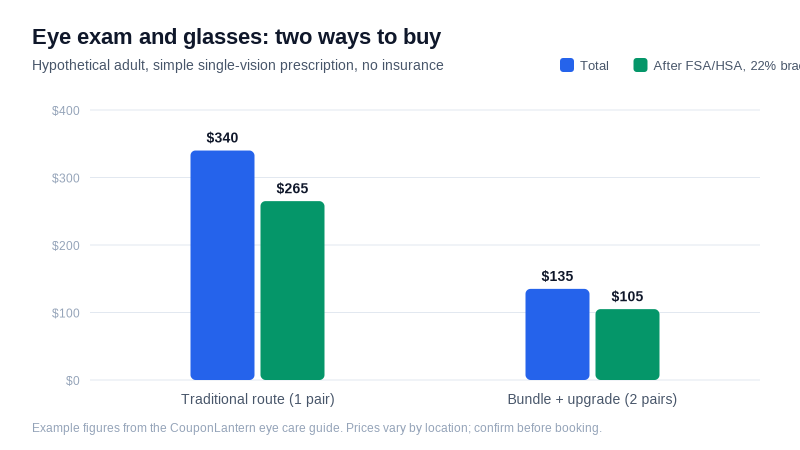
Your numbers will differ. Exam prices, coating prices and bundle prices change and vary by location, but the gap is often this wide.
Your plan, step by step
- Decide what you need: glasses only, contacts, or both. This determines the exam type.
- Price the exam and the bundle. Call one bundle chain and one private practice, and ask for prices before booking.
- If your prescription is simple, use a bundle and decline upgrades except the one you’ll notice most.
- Get your prescription and PD in writing before you leave.
- Pay with FSA or HSA money if you have it.
- Buy backups or sunglasses online with your prescription.
- Follow your doctor’s advice on exam frequency. Skipping exams to save money isn’t a saving if a condition goes unnoticed.
The bottom line
Eye care without insurance is expensive mainly when you buy everything in one place at list price. Treat the exam and the glasses as separate decisions, use a bundle deal when your prescription is straightforward, insist on getting your prescription, and pay with pre-tax money when you can. For most people, that brings the full cost below $150, and often well below.
See current offers on our America’s Best page, or browse Eye Care & Health.
Prices in this guide come from the retailers’ own offer pages and 2026 consumer price reports at the time of writing. They vary by location and change often, so confirm before booking.